Dead Rodent Removal in Tampa, FL
A rat that died inside a wall, ceiling or attic gets located, removed, and the space deodorized, then the opening it used is closed so it does not happen again. Free inspection across Tampa and Hillsborough County.
- Carcass located and removed
- Odor treated at the source
- Answered 24 hours a day
What dead rodent removal includes
Dead rodent removal finds the carcass behind the smell, takes it out, treats the spot it lay on, and closes the opening the animal used to get in. The smell is the whole reason for the call, and the smell does not leave until the body does.
The job has four parts. Locating comes first, and it is the skilled part: a dead rat in a wall cavity or under attic insulation is found by following the odor to where it is strongest, watching for flies, checking for warm spots and staining, and reading where the animal had been traveling. Removal follows, either from the attic side by lifting insulation or through a small cut in the drywall where the wall is the only way in. The area is then cleaned and treated with an odor neutralizer, because the fluids that soaked into the framing or insulation keep smelling after the body is gone. Last, the entry point is closed, since a rat that died in a wall came in through a gap that is still open.
- Odor tracing through walls, ceilings and the attic to the carcass
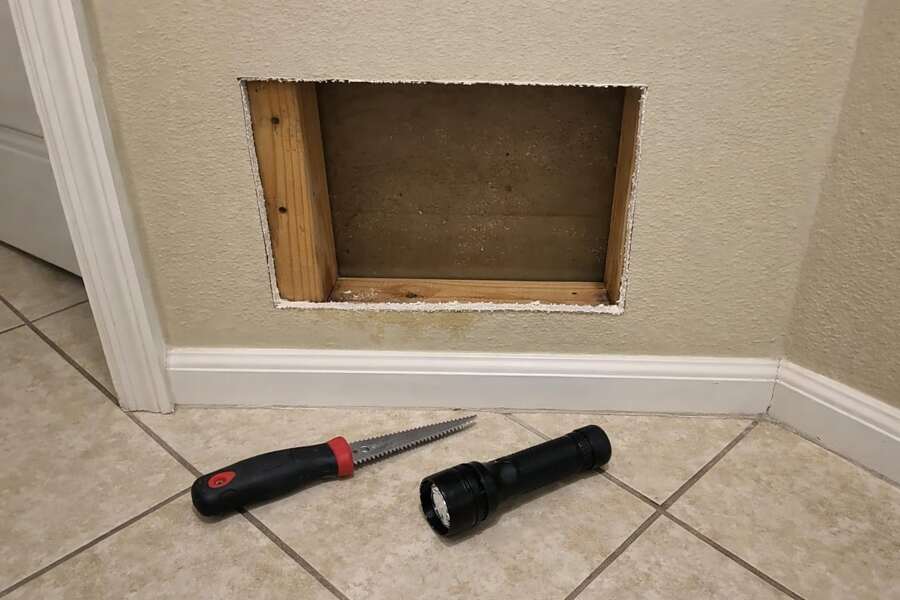
- Removal from the attic side or through a small drywall opening
- Removal of the soaked insulation or debris around the body
- Cleaning and odor neutralizer applied at the site
- Drywall opening patched or left ready for a finisher, as agreed
- The entry point the animal used sealed with steel mesh or metal
The dead-in-the-wall smell and where it comes from
The smell of a dead rat in a wall is sweet, heavy and unmistakable, and in Tampa's heat it arrives fast and lasts weeks. A roof rat runs 12 to 14 inches including the tail, by UF/IFAS's figures, and an animal that size decomposing inside a wall cavity in a house that is warm year-round produces enough odor to make a room unusable.
The odor is worst in the first one to two weeks and then fades over several more as the body dries out, and it flares when the wall warms in afternoon sun or when the air handler moves air through the cavity. A carcass on top of the ceiling drywall, under the insulation, smells strongest in the room below and along the duct runs. One inside an exterior wall smells strongest at the outlets and baseboard on that wall. The rule that works is that the smell is strongest nearest the source, and the contractor we route uses that to narrow the search before any drywall is cut.
The distress this causes is real and out of proportion to the size of the animal. People move out of bedrooms, stop having anyone over, and lie awake wondering what else is in the walls. Friends tend to say it will fade on its own. It will, eventually, and in the meantime the fluids are soaking into the framing and the reason the rat got in is still open.
Why poison-only plans put a dead rat in the wall
Most dead-in-the-wall calls follow a rodenticide program, because of how the poison works. The EPA describes the mechanism: most rodenticides in use are anticoagulants, and death typically comes four days to two weeks after the animal starts feeding. A rat that lives in your attic and feeds at a bait station in your attic spends those days going back and forth to its nest and dies where it lives, which is under your insulation or in a wall cavity it uses as a route.
The line that poison makes rats thirsty so they go outside to die is folklore, and it is used to sell bait-only work. UF/IFAS gives the practical alternative: trapping greatly reduces the risk of a poisoned rat dying inside a building and causing an odor problem. A trapped rat is in the trap. That is the whole advantage, and it is why the professional sequence in Tampa is exclusion and trapping, with rodenticide reserved for situations where a licensed operator judges it needed and can control where it is placed.
If you have already had bait put down, the dead-in-the-wall risk is now a matter of time. It is worth having the roofline sealed and traps set alongside the bait so animals that are still moving get caught before they die somewhere inconvenient. The roof rat removal page covers the trapping side, and the exclusion page covers the sealing.
How a dead rodent is located inside a house
The carcass is found by triangulating on the smell, then confirming with flies, warmth and stains before anything is opened. Cutting drywall on a guess leaves a homeowner with patched holes and the same smell, so the search is worth doing carefully.
- Odor gradient: the smell is strongest closest to the body. Whoever attends works room to room and wall to wall, sniffing at outlets, switch plates, baseboards and can lights, where air leaks out of the cavity.
- Flies: blow flies find a carcass quickly, and a cluster of large flies at a window, a light fixture or a particular wall marks the cavity they are emerging from.
- Warm spots: a body against a warm surface such as a water heater flue, a duct run or a sun-warmed exterior wall decomposes faster and smells harder. Those are checked first.
- Stains: fluids can come through ceiling drywall or drip down inside a wall to a baseboard, leaving a dark or yellowed mark that points straight at the site.
- Rodent runs: the animal died on a route it used. Rub marks, droppings and gnawed edges in the attic show which joist bays and top plates to check.
In a Tampa house the attic is checked first, because the roof rat is an attic animal and the ceiling is the most common place for a body. Insulation over the affected room is lifted bay by bay from the attic, which usually finds the carcass without touching the drywall.
Getting to the carcass through drywall or from the attic
Access from the attic is the first choice, and a drywall cut is the second, made only where the attic route cannot reach. Both are ordinary work; what matters is doing the least damage that gets the body out.
From the attic
In a slab-on-grade house with a vented attic, most of the ceiling plane and the top of every wall cavity are reachable from above. Insulation is lifted, the body is bagged, and the soaked insulation around it is removed with it. Top plates with a gap into the wall below are checked with a light and a mirror, and an animal that fell part way down can often be retrieved from above.
Through drywall
Where the rat is lodged low in a wall, behind a bathtub, or inside a soffit box, a small opening is cut at the point the odor and stains identify, the body and debris are removed, the cavity is cleaned and treated, and the opening is patched or left square-cut for a finisher, as agreed before the cut. A single small hole, placed by evidence, is the mark of someone who did the locating properly.
Deodorizing and closing
After removal, the site is cleaned and an odor neutralizer is applied to the framing, drywall back and any remaining insulation. The residual smell fades over days as the treated area dries. Then the entry point gets closed. A body in the wall means the roofline has a gap, and the contractor we route seals it with steel mesh or metal so the next animal does not follow the same route to the same end.
Is it safe to do exclusion before trapping?
Sealing before trapping is how many dead-in-the-wall calls start, so the answer is to do them together. Exclusion that closes the last opening while animals are inside leaves them trapped in the building with no way out, and a roof rat shut into an attic will chew, search, and eventually die in a cavity. The safe order is to seal the roofline, leave the runs with fresh activity open or fitted with one-way doors, trap until the traps are empty for several checks, then close the last opening.
The same logic applies after a dead rodent removal. The animal that died came in through an opening that is still there, and closing it the same day is part of the job. If there are signs of other animals still active, that opening gets a trap or a one-way door first, and the final seal follows once the attic is quiet. UF/IFAS's advice to leave traps in place at least a week, because roof rats avoid new objects, sets the minimum wait.
What happens if they come back?
A second dead rat in the same house within a season means the entry point was never closed, and the fix is the exclusion, with the removal as a symptom. The question to ask any contractor who removes a carcass is what they did about the opening, and the answer should name a place on the roofline and a material.
The warranty question belongs here too. Ask how long the seal is warrantied, whether the warranty renews, and how many follow-up visits are included if activity returns. A removal-only quote with no sealing and no warranty leaves you paying for the next smell. The attic cleanup page covers what to do when the search from the attic turns up more than one body's worth of droppings and contamination.
When the smell is a sign of a wider infestation
One dead rat is often one of several, and the search for the body regularly turns up the evidence: droppings along the joists, compressed insulation runs, a nest against the air handler, hollowed citrus carried in from the yard. UF/IFAS puts a roof rat's sexual maturity at three to four months, gestation at 21 to 23 days, and litters of five to eight, four or five times a year, so a house that has had rats long enough for one to die inside has usually had time to breed them.
The signs that point past a single carcass are worth knowing. Scratching or running overhead at night that continues after the smell started. Droppings in more than one place. Gnaw marks at a soffit edge or a gable screen. A second smell starting in a different room. Any of these turns the call from a removal into a roof rat removal job with exclusion, trapping and, once the attic is quiet, cleanup. The contractor we route says so at the inspection and prices the parts separately so you can decide what to do in what order.
What dead rodent removal costs in Tampa
Dead rodent removal runs $150 to $500 nationally by HomeGuide's 2026 figures, and that is the band to expect for a single carcass that can be reached from the attic or through one drywall cut. It is a typical-job band, and the free inspection produces the number for your house.
| Item | Typical band | Source |
|---|---|---|
| Dead rodent removal | $150 to $500 | National, HomeGuide 2026 |
| Rodent exclusion (sealing the roofline) | $550 to $1,642 | Tampa, Angi |
| Attic cleanup and decontamination, if the search finds more | $600 to $2,500 | National, HomeGuide 2026 |
The factors that move a removal quote are these.
- Where the body is: under attic insulation is the quick end, low in a wall behind tile is the slow end
- Whether drywall has to be cut and whether the patch and finish are included
- How much soaked insulation or debris has to come out with the carcass
- How long the animal has been there, which sets the cleaning and odor treatment needed
- Whether the entry point is sealed on the same visit, which is a separate line and worth having
Dead rodent calls in Tampa: heat, attics and the roof rat
Tampa's climate makes the dead-in-the-wall problem faster and worse than in a cooler city, because a carcass in a vented attic under a Florida roof or inside a sun-facing block wall decomposes in days. The species is nearly always the roof rat, which lives in the attic and dies there or in the wall cavities it uses as routes between the roofline and the kitchen. Norway rats, which burrow and keep to slabs, dumpsters and the older waterfront, turn up in dead-animal calls far less often.
The house type sets the access. Slab-on-grade with a vented attic means most bodies are reachable from above, lifting insulation over the room where the smell is worst. Pre-war and mid-century houses in Seminole Heights, Tampa Heights, Hyde Park and South Tampa have plaster or older drywall and complicated framing, so the attic route is preferred all the more. Newer block and stucco homes in New Tampa, Westchase and Riverview have simple interior stud walls that are easy to open and patch when a cut is needed.
Timing follows the rat calendar. Bait put down during a November to February cool snap, when attic activity peaks, produces the smell a week or two later. The citrus season from September to March brings rats to the yard and the attic, and the June to September rains push them indoors. After Helene and Milton in 2024, Tampa Bay pest firms reported a run of rodent calls as storm damage opened rooflines and flooding displaced rats; a poisoned animal that entered through a lifted tile after a storm is a dead-in-the-wall call waiting to happen. The post-storm inspection catches the openings first.
What to check on the contractor before the wall is opened
Confirm the FDACS credential before anyone opens a wall, because a dead rodent call almost always becomes a trapping and sealing job. Trapping rats in, on or under a structure for hire in Florida needs at minimum an FDACS Limited Commercial Wildlife Management certificate, and a company that applies rodenticide or runs a general pest business needs an FDACS Commercial Structural Pest Control license with a certified operator in General Household Pest and Rodent Control. Every contractor we route holds the FDACS credential the job needs, and the FDACS license lookup confirms it in a minute.
Then set the terms of the work before the cut. Agree on how the body will be located and what evidence will justify a drywall opening. Agree on whether the patch is included or left for a finisher. Ask what will be done about the entry point on the same visit, and get it as its own line with the material named. Ask about warranty terms on that seal and how many follow-up visits are included if activity returns. How the connection works is on the about page, and the contact page has the phone line and the form.
Services that usually go with this one
Most jobs in Tampa run as a sequence, and these are the pages that describe the steps around this one.
- Attic Cleanup and Decontamination: Removing droppings and contaminated insulation, then sanitizing the attic.
- Roof Rat Removal: Trapping out the attic rat that dominates Tampa, sequenced with sealing.
- Rodent Exclusion: Closing the roofline: soffit returns, vents, tile eaves and penetrations, to the quarter-inch standard.
Questions about how the pieces fit together are answered on the about page, or by phone at any hour.
The smell of a dead rodent
What causes it and how long it lasts.
Video: How to get rid of dead rat smell, from STOP PEST INFO.
How a dead rodent removal runs in Tampa
Find the body by evidence, take the least damaging route to it, treat the site, and close the opening it came through.
-
Free inspection and odor tracing
Whoever attends works from the room where the smell is worst, checking outlets, baseboards, lights and the attic above for the odor gradient, flies, warmth and stains.
-
Removal from the attic or through drywall
Insulation is lifted from above wherever possible; where the body is low in a wall, a small opening is cut at the point the evidence identifies. The carcass and soaked material are bagged out.
-
Cleaning and odor treatment
The site is cleaned and an odor neutralizer is applied to the framing, insulation and drywall back so the residual smell fades as the area dries.
-
Exclusion of the entry point
The opening the animal used, usually a soffit return, gable screen or tile eave, is closed with steel mesh or metal to the quarter-inch standard. If other animals are active, a trap or one-way door goes on first.
-
Follow-up and the wider check
A follow-up confirms the smell has cleared and the seal is holding, and if the search found droppings, runs or a nest, a trapping and cleanup plan is quoted with each part on its own line.

What to expect
The visit runs in the same order on every dead rodent removal job, so you know what is coming before the truck arrives.
- Search starts in the attic above the affected room
- Drywall cut only where evidence places the body
- Carcass and soaked insulation bagged and removed
- Odor neutralizer applied at the site
- Entry point named, sealed, and noted in writing
Why Tampa homeowners call us when the smell starts
The body is found before anything is cut
Locating by odor gradient, flies, warmth and stains means one small opening placed by evidence, or none at all when the attic route reaches it, which in a slab-on-grade Tampa house with a vented attic it usually does. Nobody attending your house will start cutting drywall on a guess and leave you with patched holes and the same smell. The soaked insulation comes out with the carcass and the site gets an odor treatment on the framing, so the smell leaves with the body instead of lingering in the wood.
National dead rodent removal band: $150 to $500 (HomeGuide 2026)
The opening gets closed the same visit
A rat that died in a wall came in through a gap that is still there, and removal without sealing means the next animal follows the same route to the same end. The contractor we route names the entry point, usually a soffit return, a gable screen or a tile eave, closes it with steel mesh or metal to the quarter-inch standard, and writes the location and the material on the invoice. That makes the removal the last one you pay for, and it gives you something to hold a warranty against.
UF/IFAS: trapping greatly reduces the risk of a poisoned rat dying inside a building
FDACS-licensed contractors on every job
Trapping rats in a Florida structure for hire needs at minimum an FDACS Limited Commercial Wildlife Management certificate, and rodenticide use or a general pest business needs an FDACS Commercial Structural Pest Control license with a certified operator in General Household Pest and Rodent Control. A dead rodent call nearly always turns into trapping and sealing, so the credential matters from the first visit. Every contractor we route holds the credential the job needs. Confirm it through the FDACS lookup before anyone opens a wall.
FDACS Limited Commercial Wildlife Management certificate or Commercial Structural Pest Control license
What Reddit Says About Dead Rodent Removal in Tampa
The smell of a dead animal in a wall is one of the strongest secondary fears in the homeowner threads, and it drives its own searches. The pattern people describe is the same one over and over: a company put down bait, the scratching stopped, and a week or two later a smell started in a bedroom or a hallway that nobody could find. The threads treat the line that poison makes rats go outside to die as a myth, and they treat any company that uses it as dishonest.
The vetting advice that follows is consistent. Get more than one bid for the same scope and insist on an itemized quote, because a bundled number cannot be judged. Ask whether the company traps or only baits. Ask whether they seal, because trapping without sealing is described as harvesting rats indefinitely, and sealing without dealing with the animals inside is described as the other way to end up with a body in a wall. People warn each other about companies that keep coming back for months with nothing changing, and about monitoring contracts folded into a removal price.
The questions homeowners tell each other to ask are the ones that matter for this service: what exactly is included and what is a separate line item, is the exclusion warrantied and does the warranty renew, how many follow-up visits are included, and what happens if they come back. Several posters mention being made to feel dramatic by friends over a smell, and then finding a carcass that justified every complaint.
The free inspection is built around those questions: the body located by evidence, the opening it used named and sealed, and each part of the job priced on its own line.
A typical dead rodent call in Tampa
The situation: A common call comes from a block and stucco house in Riverview in late November. A bait program was put down in the attic after a cool snap brought scratching overhead, the scratching stopped after about a week, and ten days later a sweet, heavy smell started in the hallway and got worse every afternoon. The homeowner has been sleeping with the windows open and has stopped inviting anyone over.
What gets done: The inspection starts in the attic above the hallway. The smell is strongest at a can light in the hall ceiling, and a cluster of large flies at the hall window points the same way. Lifting the blown insulation bay by bay from the attic finds the body against a duct run two bays from the light, with a patch of soaked insulation under it. The carcass and the wet material are bagged out, the joist bay is cleaned and treated, and the search of the attic finds fresh droppings along the top plate leading to an open soffit return at the back gable. The return is closed with steel mesh and a trap goes on the run for a week to confirm nothing else is moving.
How it turns out: The smell fades over the following days as the treated bay dries, the trap stays empty, and the homeowner has a named entry point, a sealed roofline and an invoice with the removal, the seal and the follow-up as separate lines.
Dead rodent questions from Tampa homeowners
The questions that come with a dead-animal smell, answered plainly.
The smell
How long will the dead rat smell last if I just leave it?
Weeks, and longer in a warm wall. The odor peaks in the first one to two weeks and fades over several more as the body dries, with flare-ups whenever the wall warms in afternoon sun or the air handler pushes air through the cavity. In Tampa's heat the decomposition is fast, which means the smell is strong early. Leaving it also leaves the fluids soaking into framing and insulation, which keep smelling after the body has dried, and it leaves the entry point open for the next animal. Removal with an odor treatment at the site is the faster end to it.
Can you find it without tearing up my walls?
Usually, and the attic is the reason. In a Tampa house with a vented attic, most of the ceiling and the top of every wall cavity can be reached from above by lifting insulation, and that is where the roof rat most often dies. Where the body is low in a wall, a single small opening is cut at the point the odor, flies and stains identify, and whether the patch is included is agreed before the cut. What you should refuse is exploratory cutting on a guess. A contractor who did the locating properly makes one hole or none.
Poison and prevention
The pest company said poison makes rats go outside to look for water. Is that true?
No. The EPA describes most rodenticides as anticoagulants that kill four days to two weeks after the animal starts feeding, and an animal that nests in your attic spends those days in your attic. There is no mechanism that sends it outdoors. UF/IFAS makes the practical point that trapping greatly reduces the risk of a poisoned rat dying inside a building and causing an odor problem, which is why the professional sequence is sealing and trapping, with bait reserved for situations a licensed operator can control. If bait is already down, set traps and seal the roofline alongside it so animals still moving are caught before they die in a cavity.
Does removing the dead rat mean the problem is over?
Only if the opening it used gets closed and nothing else is living in the attic. The removal handles the smell. The exclusion handles the cause. If the search for the body turns up droppings in more than one place, compressed insulation runs or a nest, the house has an active population, and UF/IFAS's figures on roof rat breeding, litters of five to eight up to four or five times a year, explain how quickly one animal becomes many. Ask the contractor what they found while searching, get the entry point sealed as its own line, and if there is more, get trapping and cleanup quoted separately so you can decide the order.
Still have a question? Call (813) 710-4931 and ask.

Get the smell out and the gap closed
Book a free inspection and have the body located by evidence, removed with the least damage, and the opening it used sealed on the same visit. The line is answered 24 hours a day.